

Secondhand Clothing Trade in Ghana and Its Implications

SFCN Student Lead
June 25th, 2026
This webinar, hosted by the Sustainable Fashion Consumption Research Network, brought together researchers, journalists, industry representatives, and policymakers to discuss the secondhand clothing trade in Ghana, its economic value, environmental consequences, and policy gaps. The discussion was led by panelists Edward Atorbah Binkley (Ghana Used Clothing Dealers Association), Dr. Anika Kozlowoski (University of Wisconsin Madison), Hobson Agyapong (Environmental Protection Authority, Ghana), Judith Akoto (Landfills2landmarks), Mike Anane (Journalist), as well as Dr Meital Peleg Mizrachi (Yale University) as the moderator.
The Scale and Complexity of the Trade
The panelists opened by emphasizing that Ghana's secondhand clothing market, centered around the famous Kantamanto market in Accra, is far more than a charitable flow of donated goods. As researcher Dr. Anika Koslowski framed it, what arrives in Ghana is "a mix of value and burden"- some garments are genuinely wearable and sought after, while others are damaged, low-quality, or essentially worthless on arrival. The trade directly employs approximately 2 million Ghanaians and contributed $35 million to Ghana's GDP in 2022, making it a vital economic pillar, not a peripheral activity.
The Environmental Reality on the Ground
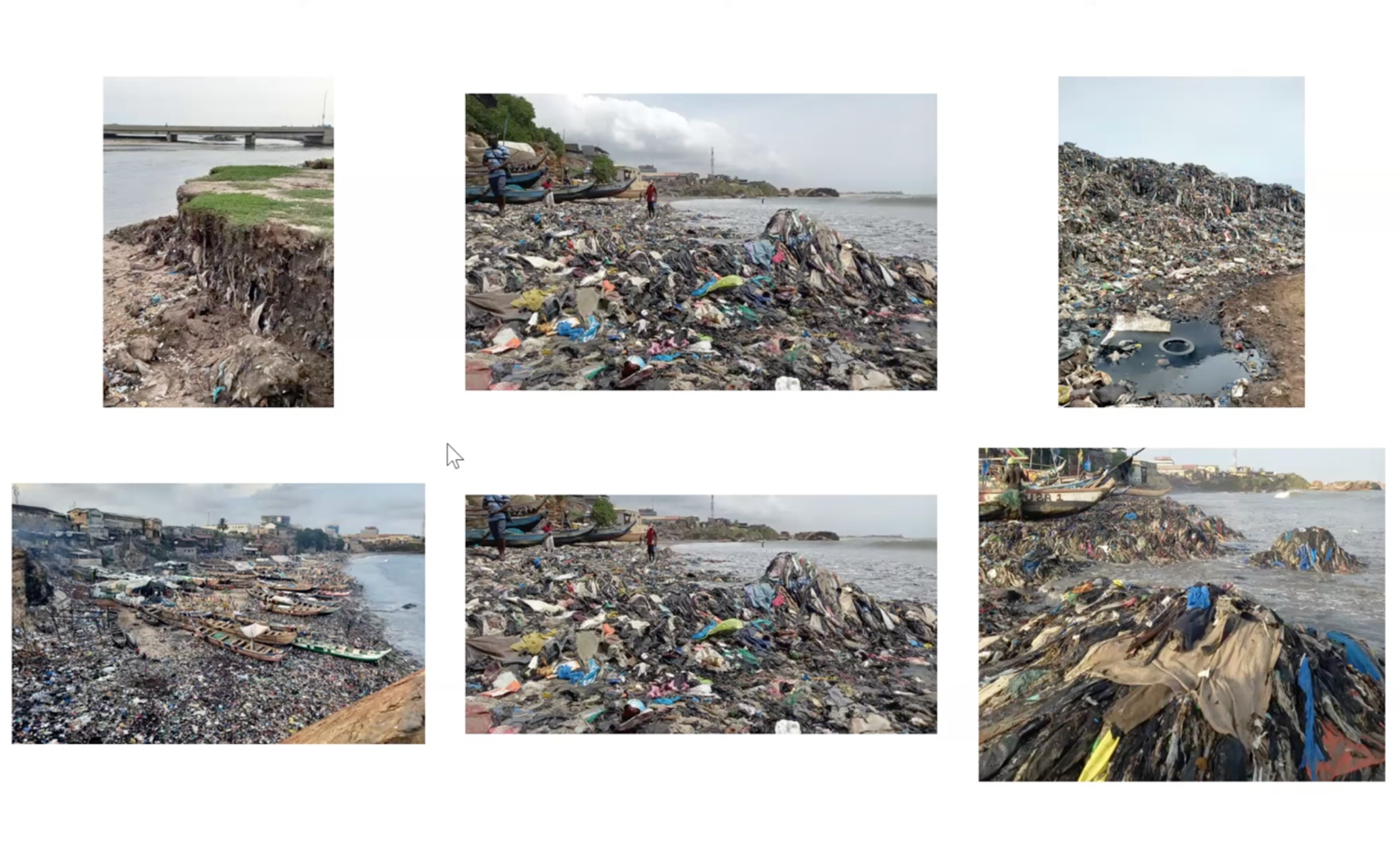
Environmental journalist Mike Anani painted a sobering picture. Fast fashion's business model has steadily degraded the quality of imported clothing, meaning a growing share arrives already unwearable. These garments end up in dump sites, choking drainage systems, silting lagoons, and littering beaches, including protected Ramsar wetland sites like the Densu Delta, which serves as habitat for migratory birds and endangered sea turtles. Fisher communities pull clothing out of their nets instead of fish, and livestock in surrounding areas consume synthetic textiles, introducing microplastics into the food chain. Mike noted that despite years of documenting these sites, he has seen no meaningful improvement.
The Contested Question of Waste Volume
One of the most debated points was the actual proportion of imported clothing that becomes waste. Ghana EPA referenced figures suggesting 30 to 40% of imports are effectively waste. The Ghana Used Clothing Dealers Association, represented by Mr. Binkley, pushed back hard, citing industry-commissioned research from 2024 “An Evaluation of the Socio-Economic and Environmental Impact of the Second-Hand Clothes Trade in Ghana” putting unsellable imports at under 5%, and argued that media coverage frequently misrepresents the situation, including images of polyethylene plastic bags being misidentified as textile waste. This tension between data sources came up repeatedly, and multiple panelists agreed that reliable, ground-level data collection remains one of the most urgent unmet needs.
Policy Gaps and the Accountability Problem
Sustainability researcher Judith Akoto identified a fundamental structural gap: secondhand clothing sits at the intersection of trade, waste, and sustainability policy, but is not fully governed by any one of them. Clothing is counted as "reused" at the point of export from wealthy countries, but there is virtually no accountability for what happens downstream. Ghana and similar importing nations are left absorbing the environmental and infrastructural costs of a global system they did not design. Ghana EPA's Hobson noted that new national legislation (Act 1124) includes provisions for Extended Producer Responsibility (EPR), though a full supporting policy and regulation framework is still being developed, with completion expected by the end of the year.
Judith also flagged that while EPR schemes are emerging in Europe and the UK, these frameworks remain nationally bounded, while textile flows are global, meaning that without international coordination, they risk simply shifting waste flows rather than resolving them.
Is Secondhand Clothing Really "The Solution"?
All panelists agreed that secondhand clothing plays a genuinely important role, extending garment lifespans, providing affordable fashion, supporting livelihoods, and reducing demand for new production. But several pushed back on the narrative that secondhand trade is a sufficient solution to fashion's sustainability crisis.
Dr. Anika made the pointed argument that when consumers in the Global North donate clothing that is already unwearable, they are effectively offshoring their waste while feeling virtuous about it. She argued that in the absence of proper recycling infrastructure, throwing a truly worn-out garment in the trash locally may actually be more responsible than donating it to be exported. Judith echoed this, noting that secondhand trade simply cannot keep pace with the volume generated by a system still built on overproduction, rapid trend cycles, and planned obsolescence. It absorbs some excess, but it functions as a moral buffer that lets the underlying problem continue unchallenged.
Paths Forward
Despite disagreements on data, all panelists converged on several priorities: better downstream data collection, meaningful producer accountability through EPR, investment in local sorting and recycling infrastructure, and consumer education in the Global North about where donated clothing actually ends up. Both Judith's traceability platform (landfills2landmarks) (the Crème Exchange) and the Ghana Used Clothing Dealers Association's proposed buyback scheme represent early practical steps toward building the evidence base needed to move policy forward. The webinar itself was framed as a hopeful beginning of an ongoing, cross-sector dialogue.
Watch the webinar here: Rethinking Circularity: The Second-Hand Clothing Trade in Ghana from Multiple Perspectives
Additional Readings: Featured Articles