

Practivism as a Pedagogical Model In Fashion

SFCN Student Lead
June 26th, 2026
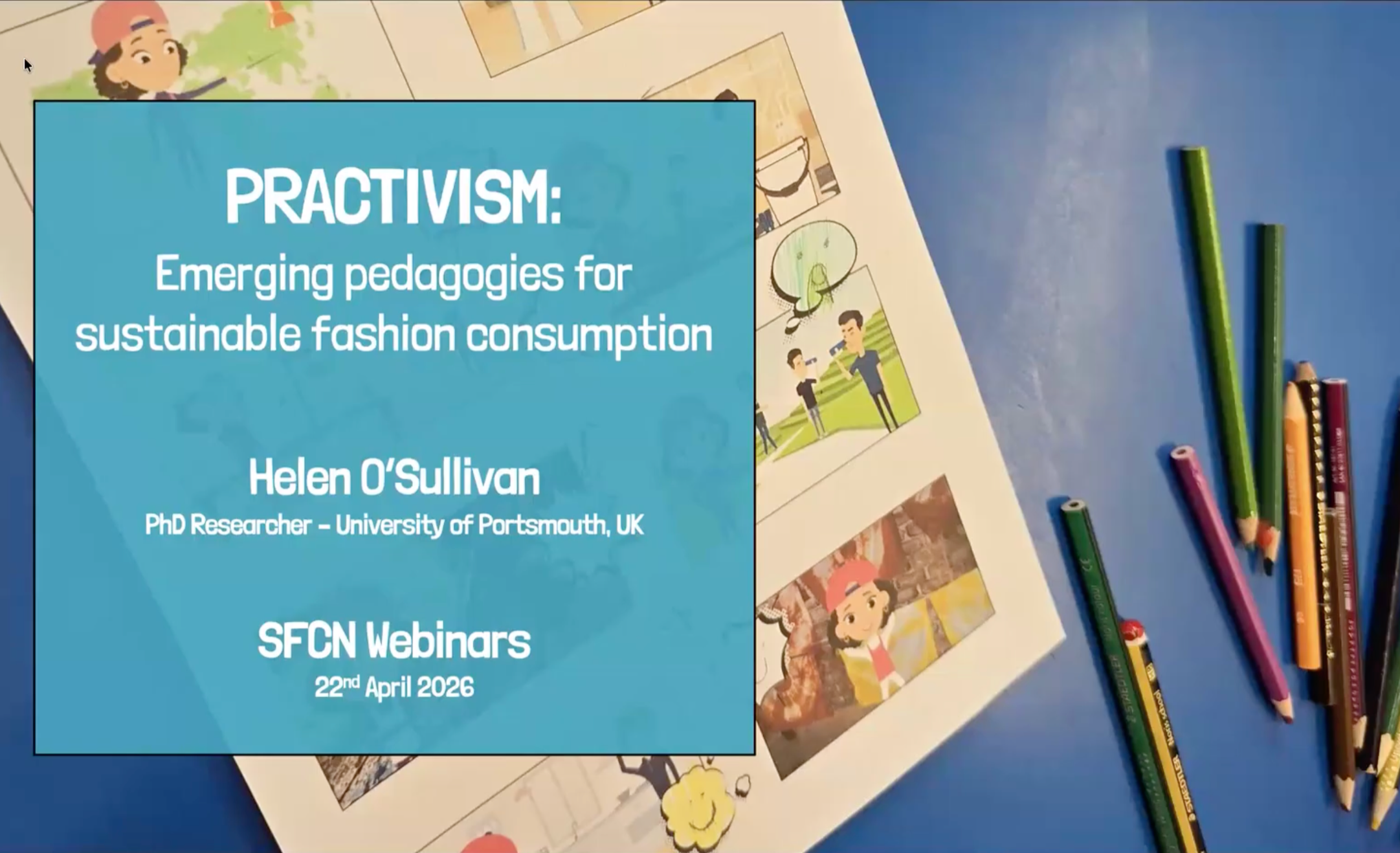
This internal session for Sustainable Fashion Consumption Research Network members featured a presentation by Helen, a PhD researcher in sustainable fashion education at the University of Portsmouth, currently in her final year of writing up. Her work sits at the intersection of critical pedagogy, art and design, and sustainable consumption, and she presented one focused aspect of her broader research: the use of practivism as a tool for engaging children and families with the social and environmental realities of fast fashion.
The Problem with Existing Approaches
Helen opened by identifying a gap that motivated her entire project. Conventional sustainability education tends to stop at awareness. It tells people what the problems are but rarely moves them toward changed behavior or meaningful action. She also noted that children are largely absent from sustainable consumption research despite being widely cited as agents of change, and that teachers face increasing workload pressures that make complex, cross-curricular topics like fashion difficult to address well. Her research set out to tackle all three of these gaps at once.
Her context is specific: she is based in South Wales, which operates under its own Curriculum for Wales, structured around the concept of cynefin, a Welsh word meaning to connect or belong to a place, nature, or community. This framework gave her unusual room to embed ethical, place-based, and participatory learning in ways that a more rigid national curriculum would not easily allow.
What Practivism Is
Helen defined practivism as an emerging pedagogical approach that blends hands-on making with civic and ethical action. Drawing on Freirean concepts of praxis, it combines reflection and action in a cyclical rather than linear way, and is designed to make complex moral and political topics accessible across ages and learning needs. In her framework, practivism runs concurrently through three theoretical pillars: Vygotsky's social constructivism, which emphasizes learning from peers, family, and knowledgeable others; Kolb's experiential learning cycle, applied through sensory and emotion-driven art and design activities; and critical consciousness, the Freirean goal of developing an understanding of one's place in unjust systems and taking action toward change.
The key distinction she emphasized is that practivism is not craft for its own sake. Every activity in her workshops was chosen because it was problem-posing, not decorative, designed to generate dialogue, emotional processing, and a sense of agency rather than simply producing a finished object.
The Research in Practice
Helen ran workshops over an academic year with families in community settings across South Wales, following the geography of a typical fashion supply chain across eight monthly sessions. Each session focused on a different location and a different problem in the industry, introduced through animated cartoons she designed herself and followed by a textile-based hands-on activity. She also trialed the workshops in primary schools with children aged six to nine. In total, around 200 participants were involved.
She screened one of the cartoons during the webinar, set in Cambodia and focusing on garment workers. Created during the Pay Up campaign, when brands including Nike and Matalan faced widespread criticism for failing to pay workers during pandemic-related factory closures, it was designed to introduce children to human exploitation for the first time, after earlier sessions had focused on environmental damage. The cartoon used a clear moral frame, positioning the fast fashion CEO as the villain and inviting children to become "superheroes" by sewing or painting messages onto fabric squares that were then stitched together into a protest banner and submitted to Fashion Revolution.
Following the cartoon, participants used an emoji-based activity sheet to draw their emotional responses to each scene, an intentionally accessible format that worked across literacy levels and opened up conversation without requiring written output.
What the Children Actually Did
The results surprised Helen in the best way. Rather than simply absorbing information and feeling sad about it, children moved toward imaginative, playful forms of justice-seeking. One boy's protest banner read "Give them more money or else," which opened a long and gleeful conversation about what that "or else" might involve, with the fast fashion CEO variously sentenced to being flushed down a toilet. A six-year-old articulated that fast fashion is "when it all goes to waste in the end." Children discussed boycotts, questioned why usable fabric was being binned, and one seven-year-old asked, unprompted, whether sustainable means handmade — a question Helen noted you could write a thesis on. One child, imagining himself as a garment worker, said to the imaginary boss: "you're just brainwashing us."
Helen was clear that she had not expected this level of critical consciousness from children this young, and that the art-based, group-based format was what made it possible. Working through making and dialogue gave the children tools to process something emotionally overwhelming without being paralyzed by it.
Challenges and What Comes Next
The Q&A surfaced two recurring practical challenges. First, time: in school settings, even enthusiastic teachers struggled to fit slow, hands-on creative activities into an already packed curriculum. Helen found that once she was in the room, teachers wanted her to come back, but getting through the door in the first place was the hardest part. Her plan post-PhD is to package the resources so they are easy to pick up off a shelf, with minimal preparation required and explicit links to curriculum frameworks. She noted that this is considerably easier in Wales than in England, where the curriculum is far more restrictive.
Second, community engagement proved uneven. The workshop group that completed the full year was an eco-minded, relatively affluent community with existing interest in the topic. A second group in an area of higher deprivation dropped off around Christmas and never returned, despite the children being enthusiastic. A third group never signed up at all. Helen was candid about this, noting that it reflected a real tension in the work: the people she most wanted to reach were the hardest to retain. She ended up with more than enough data from the one group that stayed, but the question of how to reach broader and more socioeconomically diverse audiences remains open.
Her overall conclusion was that practivism bridges the gap between awareness and action in sustainability education, and that art and design, when used intentionally and with a clear ethical purpose, can do something that conventional instruction cannot: give young people the emotional tools and the sense of agency to engage critically with systems that are genuinely unjust.
Watch the webinar recording here: Practivism as a Pedagogical Model In Fashion
Additional Readings: Featured Articles